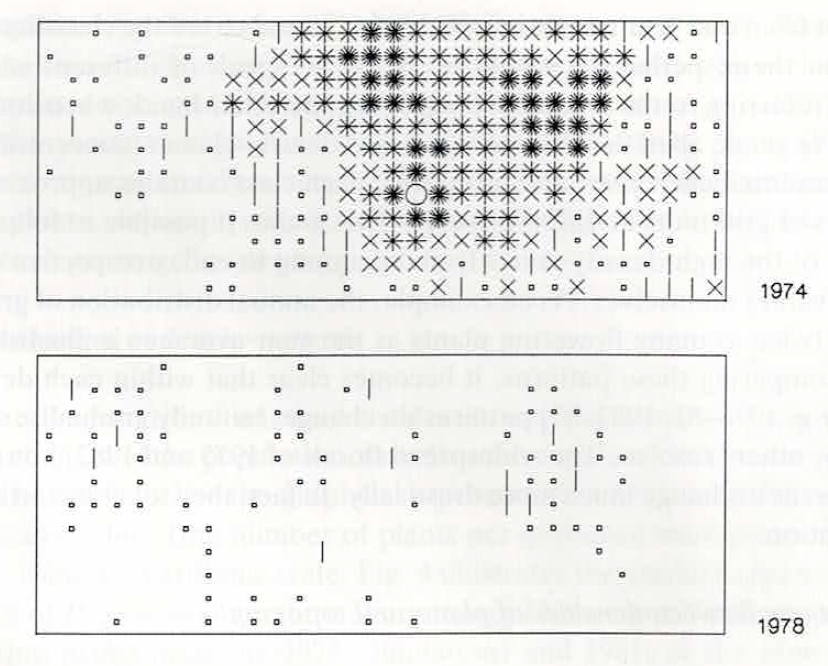
Aquí enseñamos cómo filtrar la base de datos de COMPADRE para obtener solamente las especies de la familia Orchidaceae. En este caso se usa el paquete dplyr para filtrar y contar las especies únicas de orquídeas.
La mediana de especies por familia es 3, es decir, la mayoría de las familias están representadas por muy pocas especies; unas pocas familias concentran la mayor parte de los estudios.
Alexander, C., & Alexander, I. (1984). Seasonal changes in populations of the orchid Goodyera repens Br. and in its mycorrhizal development. In: Transactions of the Botanical Society of Edinburgh (pp. 219-227). Taylor & Francis.
Bradshaw, M. E., & Doody, J. (1978). Plant population studies and their relevance to nature conservation. Biological Conservation, 14, 223-242.
Calvo, R. N. (1993). Evolutionary demography of orchids: intensity and frequency of pollination and the cost of fruiting.
Ecology,
74, 1033-1042. https://doi.org/
10.2307/1940473
Calvo, R. N., & Horvitz, C. C. (1990). Pollinator limitation, cost of reproduction, and fitness in plants: a transition-matrix demographic approach. The American Naturalist, 136, 499-516.
Campbell, V. V., Rowe, G., Beebee, T. J. C., & Hutchings, M. J. (2002). Isolation and characterization of microsatellite primers for the fragrant orchid Gymnadenia conopsea (L.) R. Brown (Orchidaceae).
Conservation Genetics,
3, 209-210. https://doi.org/
10.1023/A:1015224531795
Campbell, V. V., Rowe, G., Beebee, T. J. C., & Hutchings, M. J. (2007). Genetic differentiation among fragrant orchids (Gymnadenia conopsea s. l.) in the British Isles.
Botanical Journal of the Linnean Society,
155, 349-360. https://doi.org/
10.1111/j.1095-8339.2007.00709.x
Carey, P. (1998). Modelling the spread of Himantoglossum hircinum (L.) Spreng. at a site in the south of England. Botanical Journal of the Linnean Society, 126, 159-172.
Cochran, M. E., & Ellner, S. (1992). Simple Methods for Calculating Age-Based Life History Parameters for Stage-Structured Populations: Ecological Archives M062-002. Ecological Monographs, 62, 345-364.
Gregg, K. B. (1989). Reproductive biology of the orchid Cleistes divaricata (L.) Ames var. bifaria Fernald growing in a West Virginia meadow. Castanea, 57-78.
Gregg, K. B. (1991). Variation in Behaviour of four populations of the orchid Cleistes divaricata, an assessment using transition matriz models. In: Wells, T. C. E., & Willems, J. H. (eds.), Population Ecology of Terrestrial Orchids (pp. 139-159). SPB Academic Publishing bv, The Hague.
Hernández-Apolinar, M. (1992). Dinámica poblacional de Laelia speciosa (HBK) Schltr. (Orchidaceae). mathesis. Mexico City, Mexico: Faculdad de Ciencias, UNAM.
Hurskainen, S., Alahuhta, K., Hens, H., Jäkäläniemi, A., Kull, T., Shefferson, R. P., & Tuomi, J. (2018). Vegetative dormancy in orchids incurs absolute and relative demographic costs in large but not in small plants.
Botanical Journal of the Linnean Society,
188, 426-437. https://doi.org/
10.1093/botlinnean/boy065
Hutchings, M. J. (1987). The population biology of the early spider orchid, Ophrys sphegodes Mill. I. A demographic study from 1975 to 1984. Journal of Ecology, 75, 711-727.
Hutchings, M. J. (1989a). Population biology and conservation of Ophrys sphegodes. In: Pritchard, H. W. (ed.), Modern Methods in Orchid Conservation: The Role of Physiology, Ecology and Management (pp. 101-115). Cambridge: Cambridge University Press.
Hutchings, M. J. (1989b). Conservation and the British orchid flora. Plants Today, 2, 50-58.
Hutchings, M. J. (1990). The role of demographic studies in plant conservation: the case of Ophrys sphegodes in chalk grassland. In: Hillier, S., Wells, D., & Walton, D. W. H. (eds.), Calcareous Grasslands - Ecology and Conservation (pp. 106-111). Huntingdon: Bluntisham Books.
Hutchings, M. J. (1991). Monitoring plant populations: census as an aid to conservation. In: Goldsmith, F. B. (ed.), Monitoring for Conservation and Ecology (pp. 61-76). London: Chapman & Hall.
Hutchings, M. J., Mendoza, A., & Havers, W. (1998). Demographic properties of an outlier population of Orchis militaris L. (Orchidaceae) in England.
Botanical Journal of the Linnean Society,
126, 95-107. https://doi.org/
10.1111/j.1095-8339.1998.tb02517.x
Jäkäläniemi, A., Crone, E. E., Närhi, P., & Tuomi, J. (2011). Orchids do not pay costs at emergence for prolonged dormancy. Ecology, 92, 1538-1543.
Kéry, M., & Gregg, K. B. (2004). Demographic analysis of dormancy and survival in the terrestrial orchid Cypripedium reginae. Journal of Ecology, 92, 686-695.
Kindlmann, J. H. W., Pavel Willems (2002). Trends and fluctuations and underlying mechanisms in terrestrial orchid populations. Leiden, The Netherlands: Backhuys Publishers.
Kull, T., & Hutchings, M. J. (2006). A comparative analysis of decline in the distribution ranges of orchid species in Estonia and the United Kingdom.
Biological Conservation,
129, 31-39. https://doi.org/
10.1016/j.biocon.2005.09.046
Kull, T., Kindlmann, P., Hutchings, M. J., & Primack, R. B. (2006). Conservation biology of orchids: introduction to the special issue.
Biological Conservation,
129, 1-3. https://doi.org/
10.1016/j.biocon.2005.11.011
Lebreton, J.-D., Burnham, K. P., Clobert, J., & Anderson, D. R. (1992). Modeling survival and testing biological hypotheses using marked animals: a unified approach with case studies. Ecological Monographs, 62, 67-118.
Lesica, P., & Steele, B. M. (1994). Prolonged dormancy in vascular plants and implications for monitoring studies. Natural Areas Journal, 14, 209-212.
Mehrhoff, L. A. (1989). The dynamics of declining populations of an endangered orchid, Isotria medeoloides. Ecology, 70, 783-786.
Schefferson, R. (2002). Dormancy and survival in a rare terrestrial orchid. In: Kindlmann, P., JH, W., & Whigham, D. (eds.), Trends and Fluctuations and Underlying Mechanisms in Terrestrial Orchid Populations (pp. 53-64). Backhuys Publishers, Leiden, The Netherlands.
Shefferson, R. P. (2009). The evolutionary ecology of vegetative dormancy in mature herbaceous perennial plants.
Journal of Ecology,
97, 1000-1009. https://doi.org/
10.1111/j.1365-2745.2009.01525.x
Shefferson, R. P., Jacquemyn, H., Kull, T., & Hutchings, M. J. (2020). The demography of terrestrial orchids: life history, population dynamics and conservation. Botanical Journal of the Linnean Society, 192, 315-332.
Shefferson, R. P., Kull, T., Tali, K., & Kellett, K. M. (2012). Linking vegetative dormancy to fitness in two long-lived herbaceous perennials.
Ecosphere,
3, 1-19. https://doi.org/
10.1890/ES11-00328.1
Shefferson, R. P., Mizuta, R., & Hutchings, M. J. (2017). Predicting evolution in response to climate change: the example of sprouting probability in three dormancy-prone orchid species. Royal Society Open Science, 4, 160647.
Shefferson, R. P., Sandercock, B. K., Proper, J., & Beissinger, S. R. (2001). Estimating dormancy and survival of a rare herbaceous perennial using mark–recapture models. Ecology, 82, 145-156.
Shefferson, R. P., & Tali, K. (2007). Dormancy is associated with decreased adult survival in the burnt orchid, Neotinea ustulata. Journal of Ecology, 95, 217-225.
Sieg, C. H., & King, R. M. (1995). Influence of environmental factors and preliminary demographic analyses of a threatened orchid, Platanthera praeclara. American Midland Naturalist, 307-323.
Tali, K. (2002). Dynamics or Orchis ustulata populations in Estonia. In: Kindlmann, P., JH, W., & Whigham, D. (eds.), Trends and Fluctuations and Underlying Mechanisms in Terrestrial Orchid Populations (pp. 33-42). Backhuys Publishers, Leiden, The Netherlands.
Tamm, C. O. (1948). Observations on reproductive and survival of some perrenial herbs. Botanish Notiser, 305-321.
Tamm, C. O. (1972). Survival and flowering of some perennial herbs. II. The behaviour of some orchids on permanent plots. Oikos, 23-28.
Tremblay, R. L. (1997). Lepanthes caritensis, an endangered orchid: no sex, no future? Selbyana, 160-166.
Tremblay, R., Perez, M., Larcombe, M., Brown, A., Quarmby, J., Bickerton, D., French, G., & Bould, A. (2009). Dormancy in Caladenia: A Bayesian approach to evaluating latency. Australian Journal of Botany, 57, 340-350.
Vanhecke, L. (1991). Population dynamics of Dactylorhiza praetermissa in relation to topography and inundation. Population Ecology of Terrestrial Orchids. SPB Academic Publishing, The Hague, 15-32.
Waite, S., & Hutchings, M. (1991). The effects of different management regimes on the population dynamics of Ophrys sphegodes: analysis and description using matrix models. In: Wells, T. C. E., & Willems, J. H. (eds.), Population ecology of terrestrial orchids (pp. 161-175). SPB Academic Publishing bv, The Hague.
Wells, T. C., & Willems, J. H. (1991). Population ecology of terrestrial orchids. In:
International Orchid Symposium (1990: South Limburg, Netherlands). SPB Academic Publishing. https://doi.org/
90-5103-068-1
Wells, T., Rothery, P., Cox, R., & Bamford, S. (1998). Flowering dynamics of Orchis morio L. and Herminium monorchis (L.) R. Br. at two sites in eastern England. Botanical Journal of the Linnean Society, 126, 39-48.
Willems, J., & Bik, L. (1991). Population biology of Orchis simia in the Netherlands, 1972–1990. In: Wells, T. C. E., & Willems, J. H. (eds.), Population Ecology of Terrestrial Orchids (pp. 33-45). SPB Academic Publishing bv, The Hague.